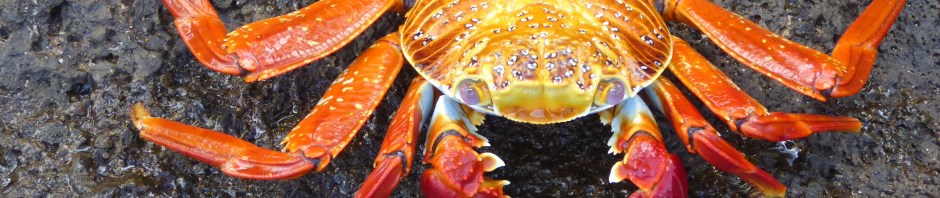
Well we managed to peel our eyelids open in time for the 4am start in the dark, which was ghastly, but we were fed before we left the B & B and our hostess drove us to the airport at 5am for our flight from Quito (via the Ecuadorian city of Guayaquil) to Baltra airport, just north of Santa Cruz Island. Very excited about finally getting to a more relaxing part of our trip and some sea, sand and wildlife and pretending to be David Attenborough for a while.
A bit of background first. There are 13 main islands in the archipelago of the Galápagos islands and many have their very own particular type of wildlife, endemic to only that particular island. Only 4 of the islands have any permanent inhabitants, the largest town being Puerto Ayura on the island of Santa Cruz, which has a population of 12,000 people. The islands are 600 miles (960 kms) west of the Ecuadorian coast and, expensive to get to, involving two flights, but oh so worth it. And we were lucky because we did get a good last minute deal on the boat.
This is where Darwin’s theory of evolution and natural selection all began, back in the 1800s, which is amazing really, as it challenged absolutely everything that people believed in before then. There is a huge statue of him overlooking beautiful Tijeretas Bay on San Cristóbal island.
We were met at Baltra airport by our portly Naturalist Guide (not to be confused with Naturist Guide i.e.naked), Freddy, and met our 13 other fellow boat people: 6 Yankee Doodles, 4 Swiss, 2 Japanese and a girl from Vancouver Island who lives in Oman. The heat hits you when you leave the plane – the temperatures in the islands are much hotter than mainland Ecuador and very humid. After a quick bus ride, short ferry ride and another 40 minute bus ride we were taken in two inflatable Zodiacs to our luxury Catamaran called EcoGalaxy II, only 6 months old, shown our rooms and given the most beautiful lunch. Then it was a few hours on Santa Cruz island, some on our own, some at the Charles Darwin centre to see the turtle breeding centre etc. Then a very refreshing first taste of snorkelling with turtles and seals around us.
The boat was AMAZING – certainly didn’t expect such enormous cabins and huge beds, so huge in fact that we wondered if each of us was in a different time zone. Everyone on the boat got on like a house on fire and we such a great social time. There were 10 staff to 15 passengers so we were very well catered for and the three meals a day were absolutely beautiful.
The good thing about being on a boat, is that you motor to a new island overnight and are there by morning, so can be on the next island in 10 minutes via Zodiac, as we were each morning at 8am. The bad part is the turbulence at night – OMG I thought catamarans were really stable and smooth but apparently not in rough seas. The first night we set off at 2am and I don’t think any of us slept much after that – the bedroom furniture was not attached to anything and there was no lip on the edge of the set of drawers so everyone’s bits and pieces fell off and rolled around on the floor while the the drawers kept opening and shutting. Eventually we stuck bandaids on them, which I think had been done before, judging by the residual stickiness there already! We were actually quite glad we hadn’t opted for the 8 night cruise. We saw and did heaps in 3 days, although it never felt rushed and we had two lengthy snorkelling trips each day as well as at least one landing/walk, so we saw endless colourful fish, seals, turtles, sting rays and the occasional shark.
We visited 4 islands in total – Santa Cruz, Floreana, Española and San Cristóbal. On Floreana there is a place called Post Office Bay, where there is a large old wooden barrel full of postcards that people visiting the island have written. The idea is that when you visit, you skim through the postcards and find one or two that you might be able to hand deliver (or if not, post) back in your own country. We found one addressed to someone in Murchison, so she may have to wait a wee while to see it again, by the time we get down there. I wonder how long it will take for our own postcard, which we left there, to be delivered?
Each island has its own particular species of animals, plants and birds and we thought Española island had the most species on offer including the Waved Albatrosses, Frigate Birds, Blue-footed and Masked Boobies, red and black Marine Iguanas, seals etc etc We also saw some stunning flamingoes. We were lucky enough to be there during the mating season of the Albatross, which is when they do the hilarious dance from side to side and then the rapid clacking-together of the beaks, which some of you may have seen on David Attenborough’s series on the Galápagos. You can get so close to them, because they have no fear of humans at all. There were also lots of seal pups around still suckling from their mothers, which is something I had never seen before. One night a seal and her pup just slithered onto the back of the catamaran after dinner and lay there feeding, which involved lots of lip-smacking and slurping noises which were hilarious.
Loads more to say about the Galápagos but I’ll let the photos tell the tale instead. After our three days on the Galaxy we saw the others off on their homeward trips from San Cristóbal island and then Steve and I found a hotel on the sea front, in the only inhabited town of Puerto Baquerizo Moreno, and booked in for 3 nights. Population is about 6000 – and about 200 seals lolling about on park benches and all around the waterfront. One of the Swiss couples from the boat, Yves and Amanda, also stayed the first night on San Cristóbal – we got on particularly well with them and so had a day and a night with them before they set off on their homeward trip after nearly a year of travelling the world. We were sad to see them go, but so grateful to them for all the info they gave us about Colombia, as they had already been there.
It was sooooooooo hot there, around 28-30 all the time and very humid, so we had a lovely relaxing couple of days to ourselves. We snorkelled in two different places for a couple of hours each – the best place was Tijeretas Bay, where we swam side by side with huge sea turtles and had a family of very boisterous seals who swam so fast around and up to us that at times I really thought we would collide. The water was beautifully clear and so warm that we didn’t need wetsuits even when we stayed in for almost 2 hours.
We absolutely loved every minute of our 6 days in the Galápagos and it’s definitely in the top three of the highlights of the trip (and probably even previous trips). Such a relaxing part of our trip. It has made us determined to try and get up to the Colombian island of San Andrés, a coral island in the Caribbean Sea this month, 750 kms (470 miles) north west of Cartagena, Colombia, so that we can end our 3 month trip with some sun, sea, relaxation and snorkelling (and not an Inca ruin or colonial church in sight).


 2 Frosty Tops Do South America